Stream API
Stream
Stream 到底是什么呢?
- 是数据渠道,用于操作数据源(集合、数组等)所生成的元素序列。
- 集合讲的是数据,Stream 讲的是计算!
- 注意:
- Stream 自己不会存储元素。
- Stream 不会改变源对象。相反,他们会返回一个持有结果的新 Stream。
- Stream 操作是延迟执行的。这意味着他们会等到需要结果的时候才执行。
- 延迟操作:只要没有执行终止操作,中间操作都不会执行;只有执行了终止操作,才会执行中间操作,并产生结果,且之后不能再被使用;如需要再次使用,需要重新创建 Stream 对象。
Stream 的操作三个步骤
- 创建 Stream
- 一个数据源(如:集合、数组),获取一个流
- 中间操作
- 一个中间操作链,对数据源的数据进行处理
- 终止操作(终端操作)
- 一旦执行终止操作,就执行中间操作链,并产生结果。之后,不会再被使用

- 创建 Stream
Stream 的实例化
/**
* 1.Stream 关注的是对数据的运算,与 CPU 打交道
* 集合关注的是数据的存储,与内存打交道
*
* 2.
* ①Stream 自己不会存储元素。
* ②Stream 不会改变源对象。相反,他们会返回一个持有结果的新Stream。
* ③Stream 操作是延迟执行的。这意味着他们会等到需要结果的时候才执行
*
*3.Stream执行流程
* ①Stram的实例化
* ②一系列的中间操作(过滤、映射...)
* ③终止操作
*
* 4.说明
* 一个中间操作链,对数据源的数据进行处理
* 一旦执行终止操作,就执行中间操作链,并产生结果。之后,不会再被使用
*
* 测试Stream的实例化
* @author Lhk
*/
public class StreamAPITest {
    //创建 Stream方式一:通过集合
    @Test
    public void test(){
        List<Employee> employees = EmployeeData.getEmployees();
        // default Stream<E> stream() : 返回一个顺序流
        Stream<Employee> stream = employees.stream();
        // default Stream<E> parallelStream() : 返回一个并行流
        Stream<Employee> employeeStream = employees.parallelStream();
    }

    //创建 Stream方式二:通过数组
    @Test
    public void test1(){
        int[] arr=new int[]{1,2,3,4,5,6};
        //调用Arrays类的 static <T> Stream<T> stream(T[] array): 返回一个流
        IntStream stream = Arrays.stream(arr);
        Employee e1=new Employee(1001,"Lhk");
        Employee e2=new Employee(1002,"lhk");
        Employee[] employees=new Employee[]{e1,e2};
        Stream<Employee> stream1 = Arrays.stream(employees);
    }

    //创建 Stream方式三:通过Stream的of()
    @Test
    public void test2(){
        Stream<Integer> integerStream = Stream.of(1, 2, 3, 4, 5, 6, 7, 8, 9);
    }

    //创建 Stream 方式四:创建无限流
    @Test
    public void test3(){
        // 迭代
        // public static<T> Stream<T> iterate(final T seed, final UnaryOperator<T> f)
        //遍历前十个偶数
        Stream.iterate(0,t->t+2).limit(10).forEach(System.out::println);
        // 生成
        // public static<T> Stream<T> generate(Supplier<T> s)
        //遍历十个[0,1)的随机数
        Stream.generate(Math::random).limit(10).forEach(System.out::println);
    }

}
Stream 的中间操作
- 多个中间操作可以连接起来形成一个流水线,除非流水线上触发终止操作,否则中间操作不会执行任何的处理!而会在终止操作时一次性全部处理,称为“惰性求值”
筛选与切片
方 法 描 述 filter(Predicate p) 接收 Lambda, 从流中排除某些元素 distinct() 筛选,通过流所生成元素的 hashCode()和equals()去除重复元索limit(long maxSize) 截断流,使其元素不超过给定数量 skip(long n) 跳过元素,返回一个扔掉了前 n 个元素的流。
若流中元素不足 n 个,则返回一个空流。与limit(n)互补映射
方 法 描 述 map(Function f) 接收一个函数作为参数,该函数会被应用到每个元素上,并将其映射成一个新的元素。 mapToDouble(ToDoubleFunction f) 接收一个函数作为参数,该函数会被应用到每个元素上,产生一个新的 DoubleStream。 mapTolnt(TolntFunction f) 接收一个函数作为参数,该函数会被应用到每个元素上,产生一个新的 IntStream mapToLong(ToLongFunction f) 接收一个函数作为参数,该函数会被应用到每个元素上,产生一个新的 LongStream。 flatMap(Function f) 接收一个函数作为参数,将流中的每个值都换成另一个流,然后把所有流连接成一个流
例
/**
* 测试Stream的中间操作
* @author Lhk
*/
public class StreamAPITest1 {
    //1.筛选与切片
    @Test
    public void test(){
        List<Employee> employees = EmployeeData.getEmployees();
        // filter(Predicate p) 接收 Lambda ,从流中排除某些元素
        //查询员工表中薪资大于5000的员工信息
        Stream<Employee> stream = employees.stream();
        stream.filter(e->e.getSalary()>5000).forEach(System.out::println);
        System.out.println();
        // limit(long maxSize) 截断流,使其元素不超过给定数量
        employees.stream().limit(3).forEach(System.out::println);
        System.out.println();
        // skip(long n) 跳过元素,返回一个扔掉了前 n 个元素的流。若流中元素不足 n 个,则返回一个空流。与 limit(n) 互补
        employees.stream().skip(3).forEach(System.out::println);
        System.out.println();
        // distinct() 筛选,通过流所生成元素的 hashCode() 和 equals() 去除重复元素
        employees.add(new Employee(1009,"雷军",55,8000));
        employees.add(new Employee(1009,"雷军",55,8000));
        employees.add(new Employee(1009,"雷军",55,8000));
        employees.stream().distinct().forEach(System.out::println);
    }

    //映射
    @Test
    public void test1(){
        // map(Function f) 接收一个函数作为参数,该函数会被应用到每个元 素上,并将其映射成一个新的元素。
        List<String> list = Arrays.asList("aa", "bb", "cc", "dd");
        list.stream().map(s -> s.toUpperCase()).forEach(System.out::println);
        //练习:获取员工姓名长度大于3的员工姓名
        List<Employee> employees = EmployeeData.getEmployees();
        Stream<String> nameStream = employees.stream().map(Employee::getName);
        nameStream.filter(name->name.length()>3).forEach(System.out::println);
        System.out.println();
        //map与flatMap的区别
        Stream<Stream<Character>> streamStream = list.stream().map(StreamAPITest1::fromStringToStream);
        streamStream.forEach(s->s.forEach(System.out::println));
        System.out.println();
        // flatMap(Function f) 接收一个函数作为参数,将流中的每个值都换成另一个流(提取每一个值作为分别作为一个流),然后把所有流连接成一个流
        Stream<Character> characterStream = list.stream().flatMap(StreamAPITest1::fromStringToStream);
        characterStream.forEach(System.out::println);
    }

    //将字符串中的多个字符构成的集合转换为对应的Stream的实例
    public static Stream<Character> fromStringToStream(String str){
        ArrayList<Character> list=new ArrayList<>();
        for (Character c:str.toCharArray()){
            list.add(c);
        }
        return list.stream();
    }

    //排序
    @Test
    public void test2(){
        // sorted() 产生一个新流,其中按自然顺序排序
        List<Integer> list = Arrays.asList(15, 22, 13, 65, 55, 43, 21, 51);
        list.stream().sorted().forEach(System.out::println);
        //抛异常,原因:Employee没有实现Comparable接口
        // List<Employee> employees = EmployeeData.getEmployees();
        // employees.stream().sorted().forEach(System.out::println);
        // sorted(Comparator com) 产生一个新流,其中按比较器顺序排序(定制排序)
        List<Employee> employees = EmployeeData.getEmployees();
        employees.stream().sorted((e1,e2)-> {
            int ageValue = Integer.compare(e1.getAge(), e2.getAge());
            if (ageValue!=0){
                return ageValue;
            }else{
                return Double.compare(e1.getSalary(), e2.getSalary());
            }
        }).forEach(System.out::println);
    }
}
Stream 的终止操作
相关方法
方 法 描 述 count() 返回流中元素总数 max(Comparator c) 返回流中最大值 min(Comparator c) 返回流中最小值 forEach(Consumer c) 内部迭代 (使用 Collection 接口需要用户去做迭代,称为外部迭代。
相反,StreamAPI使用内部迭代--它帮你把迭代做了)归约
方 法 描 述 reduce(T iden, BinaryOperator b) 可以将流中元素反复结合起来,得到一个值。返回 T reduce(BinaryOperator b) 可以将流中元素反复结合起来,得到一个值。返回 Optional<T>- map 和 reduce 的连接通常称为 map-reduce 模式,因 Google 用它来进行网络搜索而出名
收集
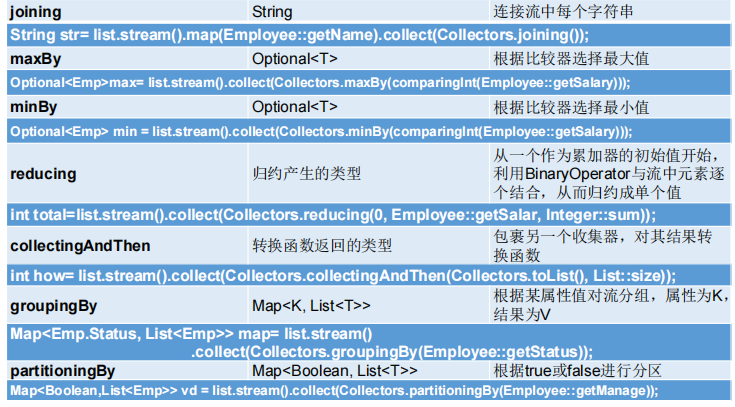
方 法 描 述 collect(Collector c) 将流转换为其他形式。接收一个 Collector接口的实现,用于给Stream中元素做汇总的方法 Collector 接口中方法的实现决定了如何对流执行收集的操作(如收集到 List、Set、Map)
另外, Collectors 实用类提供了很多静态方法,可以方便地创建常见收集器实例,具体方法与实例如下表:
例
/**
* 测试 Stream 的终止操作
* @author Lhk
*/
public class StreamAPITest2 {

    //匹配与查找
    @Test
    public void test1(){
        List<Employee> employees = EmployeeData.getEmployees();
        // allMatch(Predicate p) 检查是否匹配所有元素
        //练习:是否所有的员工的年龄都大于18岁
        boolean allMatch = employees.stream().allMatch(e -> e.getAge() > 18);
        System.out.println(allMatch);
        // anyMatch(Predicate p) 检查是否至少匹配一个元素
        //练习:是否存在员工的工资大于10000
        boolean anyMatch = employees.stream().anyMatch(e -> e.getSalary() > 10000);
        System.out.println(anyMatch);
        // noneMatch(Predicate p) 检查是否没有匹配所有元素
        //练习:是否存在员工姓“雷”
        boolean noneMatch = employees.stream().noneMatch(e -> e.getName().startsWith("雷"));
        System.out.println(noneMatch);
        // findFirst() 返回第一个元素
        Optional<Employee> first = employees.stream().findFirst();
        System.out.println(first);
        // findAny() 返回当前流中的任意元素
        Optional<Employee> any = employees.parallelStream().findAny();
        System.out.println(any);
    }

    @Test
    public void test2(){
        List<Employee> employees = EmployeeData.getEmployees();
        // count() 返回流中元素总数
        long count = employees.stream().filter(e->e.getSalary()>5000).count();
        System.out.println(count);
        // max(Comparator c) 返回流中最大值
        //练习:返回最高的工资
        Stream<Double> salaryStream = employees.stream().map(e -> e.getSalary());
        Optional<Double> max = salaryStream.max((Double::compare));
        System.out.println(max);
        // min(Comparator c) 返回流中最小值
        //练习返回工资最低的员工
        Optional<Employee> employee = employees.stream().min((e1, e2) -> Double.compare(e1.getSalary(), e2.getSalary()));
        System.out.println(employee);
        // forEach(Consumer c) 内部迭代(使用Collection接口需要用户去做迭代,称为外部迭代。相反,Stream API 使用内部迭代——它帮你把迭代做了)
        employees.stream().forEach(System.out::println);
    }

    //规约
    @Test
    public void test3(){
        // reduce(T identity, BinaryOperator b) 可以将流中元素反复结合起来,得到一 个值。返回 T
        //练习:计算1-10的自然数的和
        List<Integer> list = Arrays.asList(1, 2, 3, 4, 5, 6, 7, 8, 9, 10);
        Integer reduce = list.stream().reduce(0, Integer::sum);
        System.out.println(reduce);
        // reduce(BinaryOperator b) 可以将流中元素反复结合起来,得到一 个值。返回 Optional<T>
        //练习:计算所有员工的工资总和
        List<Employee> employees = EmployeeData.getEmployees();
        Stream<Double> salaryStream = employees.stream().map(e -> e.getSalary());
        // Optional<Double> SUM = salaryStream.reduce(Double::sum);
        Optional<Double> SUM = salaryStream.reduce((d1, d2) -> d1 + d2);
        System.out.println(SUM);
    }

    //收集
    @Test
    public void test4(){
        // collect(Collector c) 将流转换为其他形式。接收一个Collector接口的实现,用于给Stream中元素做汇总的方法
        //练习:查找工资大于6000的员工,结果返回为一个List或Set
        List<Employee> employees = EmployeeData.getEmployees();
        List<Employee> employeeList = employees.stream().filter(e -> e.getSalary() > 6000).collect(Collectors.toList());
        employeeList.forEach(System.out::println);
        System.out.println();
        Set<Employee> employeeSet = employees.stream().filter(e -> e.getSalary() > 6000).collect(Collectors.toSet());
        employeeSet.forEach(System.out::println);
    }
}